
Jiuzhaigou Valley: Basic Facts
Jiuzhaigou Valley is a national park and nature reserve in northern Sichuan, China. It is a UNESCO World Heritage Site and a AAAAA-rated scenic area, the top grade in China's official rating system for tourist sites. The reserve covers roughly 720 square kilometres of forested mountains, and its name comes from the nine Tibetan villages that sit inside the valley.
Where It Is
Jiuzhaigou lies in Aba Prefecture, in the north of Sichuan Province, close to the border with Gansu. The park entrance is at Zhangzha Town in Jiuzhaigou County, about 400 km north of Chengdu.
Most travellers reach it one of two ways. The fastest is to fly into Jiuzhai Huanglong Airport, about 88 km from the park gate, then take a shuttle bus or private car for the rest of the journey. The cheaper route is a long-distance bus from Chengdu, which takes around 8 to 9 hours on mountain roads. Many visitors combine the valley with Huanglong, which is on the same road from the airport.
How the Valley Came to Be Protected
Jiuzhaigou was little known outside the region until the 1970s, when logging operations reached the valley. A campaign to stop the logging led to the area being made a nature reserve in 1978. It opened to visitors in the 1980s, was listed as a UNESCO World Heritage Site in 1992, and became a national park as part of China's national park system in 2021. The Tibetan villages inside the reserve are still lived in today.
Main Scenic Spots
The park is shaped like a Y, with three gullies meeting at a central junction. Shuttle buses run along all three.
- Shuzheng Valley — the main valley from the entrance. It holds a chain of terraced lakes and the Shuzheng Lakes and waterfalls.
- Rize Valley — home to the Five Flower Lake, the Pearl Shoal Waterfall and the Nuorilang Waterfall, which is one of the widest in China.
- Zechawa Valley — the longest and highest of the three, ending at Long Lake and the Five Colour Pond.
- Long Lake — the largest and deepest lake in the park, at around 3,000 m above sea level.
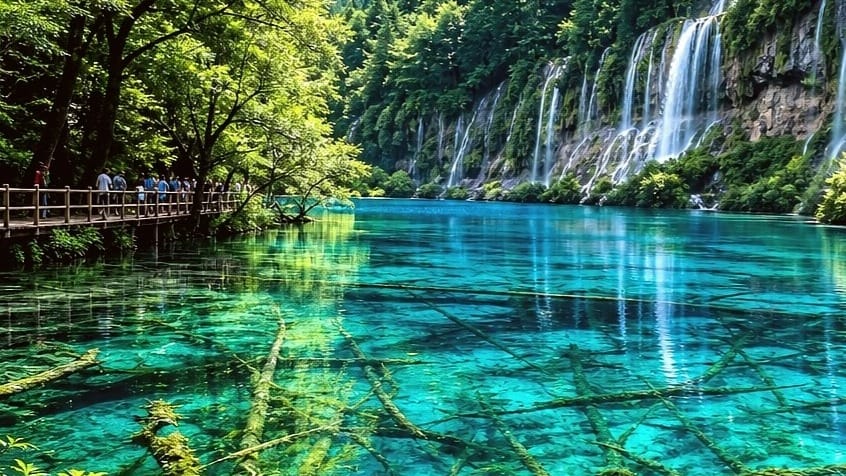
- Five Flower Lake — shallow, clear water over sunken logs, with colours that shift through the day.
- Mirror Lake — still water that reflects the surrounding forest and peaks.
- Nuorilang Waterfall — about 320 m wide, and the best-known waterfall in the valley.
- Pearl Shoal Waterfall — a wide curtain of water over a shallow, stepped shoal.
What to See First
Five Flower Lake. The colours here are the reason many people come. Fallen trees lie in the shallow water, and the mineral-rich lake shifts from turquoise to green to yellow as the light changes. Come early, before the tour groups arrive.
Nuorilang Waterfall. At roughly 320 m across, it is a broad, loud wall of water right beside the main road through the park. It is easy to reach and worth a proper stop rather than a photo from the bus.
Long Lake. Sitting at about 3,000 m, this is the biggest lake in the reserve, ringed by mountains. The walk along the shore is short and the views open up quickly.
Mirror Lake. On a calm morning the water is almost perfectly still, and the forest and peaks above it show up clearly in the surface. It is a quiet counterpoint to the busier stops.
Opening Hours and When to Go
The park is generally open from roughly 08:00 to 17:00, with hours adjusted by season. Tickets are sold by season:
- Peak season (Apr 1–Nov 15): ¥190 entrance plus ¥90 shuttle bus, ¥280 per person.
- Off season (Nov 16–Mar 31): ¥80 entrance plus ¥80 shuttle bus.
Online booking is required, and daily visitor numbers are capped, so reserve your ticket before you travel.
September and October are the best months to visit, when the autumn colours peak. The park is large and fills up quickly, so start early and use the shuttle buses to move between the three gullies.